A spec sheet is not hardware. Between the two sit component choices, sample runs, test iterations and a factory that has to build the result repeatably. We coordinate that path through Shenzhen — from requirement to flight-ready hardware — with one accountable counterparty throughout.
Working samples before committed volume. We coordinate prototype builds with Shenzhen factories — sourcing candidate components, arranging sample runs and keeping engineering questions moving between your team and the production line in one thread.
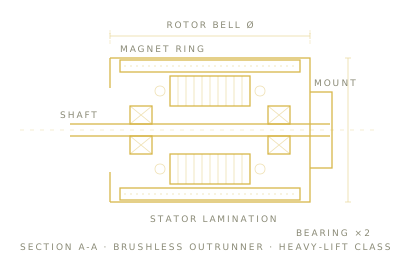
We help match powertrain components — motor, propeller and ESC — to your airframe requirements: target thrust, endurance, voltage and payload. Candidate options arrive with datasheets and available test data, so trade-offs are settled on paper before money moves.
For distributors who need hardware under their own name. OEM and white-label programs run through our Shenzhen operations, scoped case-by-case — and documented with the same discipline as everything else we ship.
Lthunder, the group's affiliated AI-drone brand, engineers its own flight controllers and ESCs. That in-house engineering experience informs how we vet components for clients — the questions we put to a factory are the same ones our own engineers ask of their hardware.
About the brand →It starts with your numbers — airframe, target thrust, endurance, voltage, payload and operating environment. We turn the requirement into a component brief the factory floor can act on.
A candidate bill of materials with datasheets and available test data, followed by samples of the shortlisted components for your own bench.
Prototype builds and test findings loop between your engineers and the factories — revisions coordinated in English, decisions recorded as they are made.
The frozen specification goes to production. Every batch clears our standard inspection gates before export — documented lot by lot.
Most engineering programs fail in the gaps — between languages, between revisions, between what was discussed and what was written down. Our role is to close those gaps: one counterparty, one thread, one record of what was agreed.
How we source components →Yes — within an OEM program. Complete-aircraft and sub-assembly builds run through our Shenzhen operations and are scoped case-by-case: requirement, volumes and compliance context are reviewed before we commit. Start with the spec sheet, and we will tell you plainly what we can and cannot take on.
The client. Design files, specifications and documentation you bring to a program — or that are developed to your requirement within it — remain your property. We operate NDA-friendly: confidentiality terms can be agreed before any technical material is exchanged.